In brief
Choose RoadWarrior when you already know the stops and need an efficient work route for deliveries, service calls, sales visits, or a team of drivers. Choose Ownway when you know the destination but not the places: describe the coffee, meal, viewpoint, hotel, or attraction you want, let Ownway find and order suitable stops, then navigate with Apple Maps, Google Maps, or Waze.
RoadWarrior vs Ownway at a glance
| Dimension | RoadWarrior | Ownway |
|---|---|---|
| Best fit | Delivery drivers, field teams, contractors, and other professionals with known stops | Road trips and unfamiliar drives where the desired stops are not yet known |
| What you provide | Addresses, map locations, or an imported stop list | Origin, destination, and a description of what you want along the way |
| Main job | Optimize and operate a multi-stop work route | Find suitable places, order them, and show the route trade-off |
| Useful controls | Stop order, route settings, time windows, priorities, imports, check-ins, and team workflows | Stop purpose, timing, preferences, route position, and detour tolerance |
| Navigation | Built-in route workflow plus handoff to supported navigation apps | Handoff to Apple Maps, Google Maps, or Waze Companion |
| Best question | What is the most efficient way to visit these locations? | Which places best match what I want on this drive? |
The products overlap around multi-stop drives, but they solve different parts of the planning process. RoadWarrior expects the destinations to be known. Ownway is useful one step earlier, when a stop is still an idea such as “lunch near the route” rather than an address.
Choose RoadWarrior for professional routes with known stops
RoadWarrior describes itself as route-optimization software for individual professional drivers and teams. Its workflow begins by adding the stops, then creating or optimizing the route, and finally navigating through the day.
That order matches delivery and field-service work. A courier already has customer addresses. A technician already has a list of appointments. The problem is fitting those required locations into a practical sequence while respecting the workday.
RoadWarrior's current official pages highlight capabilities such as:
- automatic or manual ordering of known stops;
- spreadsheet and delivery-manifest imports on supported plans;
- route settings, delivery windows, priorities, and repeat routes;
- check-ins and proof-of-visit workflows;
- dispatcher, assignment, and driver-tracking tools for teams;
- handoff to Apple Maps, Google Maps, or Waze where supported.
Those are meaningful advantages. If missing a customer visit or appointment window has operational consequences, a professional route optimizer is the sensible choice. Ownway is not a fleet-management, dispatch, manifest-import, or proof-of-delivery system.
Choose Ownway when you do not know the place names
Ownway begins with a destination and a plain-language description of what would make the drive better.
For example:
Drive from Denver to Moab. Find excellent coffee after about 90 minutes, a relaxed lunch close to the route, and one viewpoint worth the stop if it adds no more than 20 minutes.
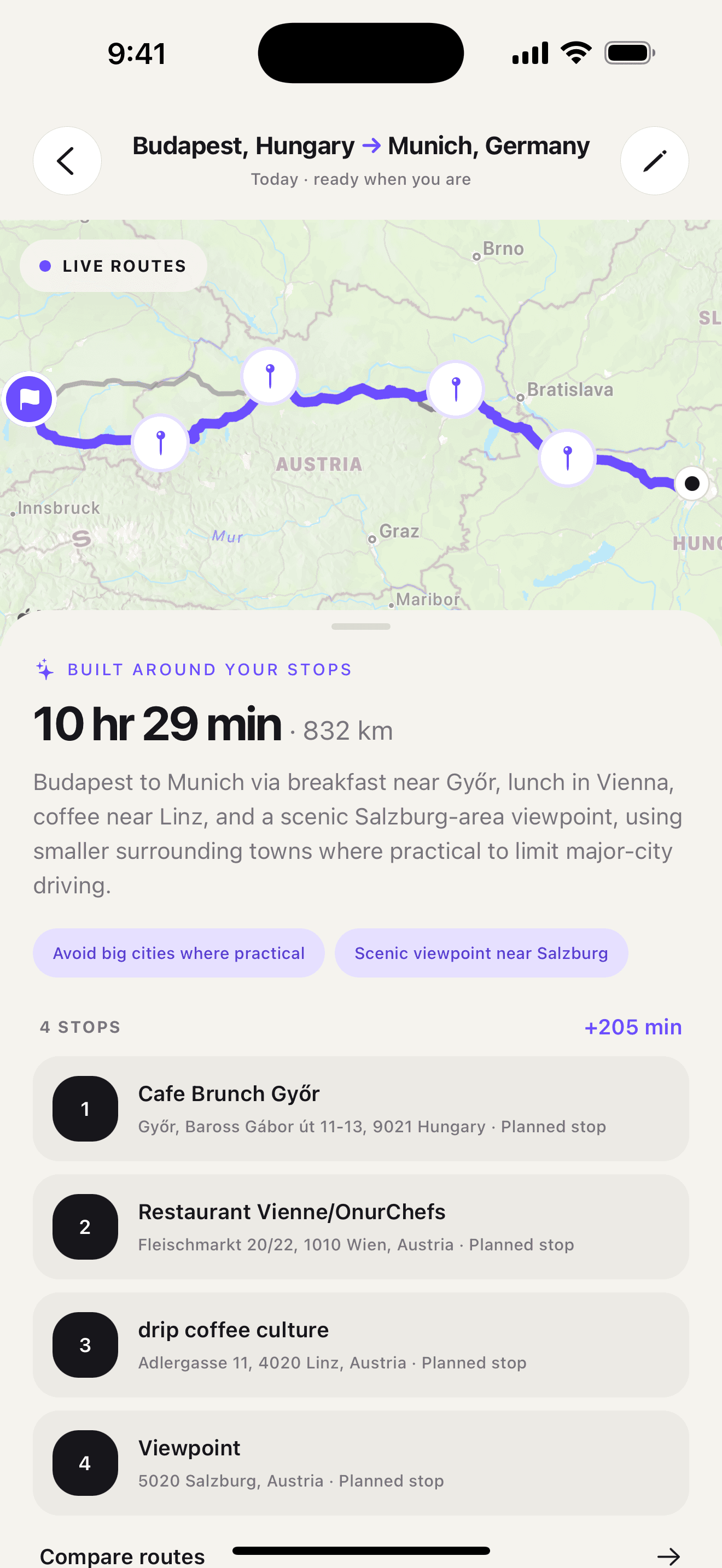
The request contains preferences, timing, and a detour limit—but no venue names or addresses. Ownway finds real places that fit the brief, orders them along the drive, and shows the planned route before handing navigation to Apple Maps, Google Maps, or Waze Companion.
That is a different task from optimizing a delivery list. If you are still researching where to stop, read the practical guide to finding useful stops along a route without large detours.
If this is the planning problem you have, get Ownway from the App Store or Google Play.
Known-address optimization and stop discovery are different jobs
Route optimization begins after every destination has become a concrete location. The planner can compare possible orders, apply constraints, and reduce unnecessary travel.
Stop discovery begins earlier. “A clean rest stop halfway,” “a family-friendly restaurant near the highway,” and “a scenic place with a short detour” are requirements, not destinations. Someone—or something—must identify suitable places before the route can be ordered.
Use this test:
- If you can paste every required stop into a spreadsheet, RoadWarrior is likely the better fit.
- If several stops are still descriptions, Ownway is likely the better starting point.
- If the drive mixes mandatory work stops with one optional break, keep the professional route authoritative and add the optional place only if it does not disrupt the schedule.
- If every stop is known and the route is simple, Apple Maps or Google Maps may already be enough.
The distinction matters more than the number of stops. A five-stop delivery route can need work controls that a ten-stop vacation does not. A two-stop road trip can still require discovery if the traveler wants “the best lunch with a small detour” but has no idea where that is.
Practical example: a service day and a weekend escape
A field-service schedule
A technician starts at a depot, must visit nine customers, has three appointment windows, and returns to the depot. Every address is fixed, and the route may need to change when a job runs late.
RoadWarrior is the better fit. Its professional route optimization, stop controls, check-ins, and team-oriented options are designed around this kind of day. Ownway would not replace those operational tools.
A weekend drive to a known destination
A couple is driving six hours to a cabin. They want breakfast after leaving the city, a short walk around the halfway point, and dinner near the cabin—but they do not know the towns or venues along the route.
Ownway is the better starting point. The travelers can describe the experience they want and the detours they will accept instead of researching every candidate place before planning.
RoadWarrior could optimize the final addresses once they were selected, but it would not answer the earlier question: which breakfast spot, walking stop, and restaurant actually fit this drive?
What if you use Waze for navigation?
RoadWarrior and Ownway both separate planning from at least part of the final navigation workflow. The planner keeps the route context; the navigation app handles the active directions.
When every address is already known and you only need a lightweight Waze itinerary, the free Waze multiple-stops planner can organize the stops into a shareable, leg-by-leg route. It does not discover places or provide RoadWarrior's professional operations features.
Ownway's Waze Companion keeps the complete planned trip in Ownway and opens each leg in Waze. Apple Maps and Google Maps can also receive supported routes directly.
Which route planner should you choose?
- Choose RoadWarrior for deliveries, service calls, sales visits, inspections, or team routes where the required addresses are already known.
- Choose Ownway for leisure drives where you know what kind of stops you want but need help finding the actual places.
- Use a standard maps app directly when every stop is known and the trip does not need optimization or discovery.
- Use both kinds of tool deliberately if discovery happens first and professional route operations take over afterward.
RoadWarrior helps you visit the places already on your work list. Ownway helps identify the places that should be on your trip.
For more choices organized by planning job, compare the best road-trip planner apps or browse the Ownway road-trip guides.
Sources
- RoadWarrior route optimization for professional driversRoadWarrior · Accessed November 2, 2026
- RoadWarrior Getting StartedRoadWarrior Support · Accessed November 2, 2026
- RoadWarrior Optimization and Manual OrderRoadWarrior Flex Guide · Accessed November 2, 2026
- ownway - Route & Stop PlannerApple App Store · Accessed November 2, 2026
- Ownway - Route & Stop PlannerGoogle Play · Accessed November 2, 2026