In brief
For a long road trip, use a break of at least 15 minutes after about every two hours of driving as a practical planning benchmark. That rhythm comes from the UK Highway Code, but it is not permission to continue until the clock reaches two hours. Stop sooner in a safe place if you feel sleepy, lose concentration, need to change drivers, or a passenger or practical need cannot wait. Do not begin a long drive tired.
Treat two hours as a planning checkpoint
There is no single interval that makes every driver, road, vehicle, and journey safe. Alertness can change with sleep, time of day, medication, traffic, weather, road monotony, and the demands of the vehicle. Passengers may also need an earlier restroom, movement, food, or care break.
For a usable starting point, the UK Highway Code recommends planning at least 15 minutes of break time after every two hours of driving. That gives a long journey a structure before anyone gets tired or starts making rushed searches from the road.
The two-hour mark is a checkpoint, not a target to push through. If concentration drops after 70 minutes, the correct break is after 70 minutes. If the planned stop is closed or inaccessible, use the safe fallback rather than extending the drive simply to preserve the schedule.
Stop sooner when tiredness appears
A scheduled break cannot make tired driving safe. The National Highway Traffic Safety Administration says adequate sleep is the only true protection against drowsy driving and advises drivers not to begin a long family trip without a good night's sleep.
Do not wait for the planned stop if you notice warning signs. NHTSA specifically points to crossing lane lines or hitting a rumble strip as signs that demand attention. If you are struggling to stay awake, stop driving and pull over somewhere safe. A motorway shoulder or emergency area is not a rest stop.
NHTSA describes caffeine followed by a short nap in a safe, designated place as a temporary intervention when sleepiness starts. CDC/NIOSH similarly stresses that caffeine and a short nap are temporary measures; sleep is the remedy for fatigue. Opening a window, turning up the radio, or trying to “power through” is not a break plan.
Also plan around time of day. NHTSA identifies midnight to 6 a.m. and late afternoon as peak sleepiness periods. The Highway Code recommends avoiding long journeys between midnight and 6 a.m. where possible. If the route requires driving at a difficult time, the safest plan may be a different departure, another driver, or an overnight stop rather than more tightly packed pauses.
Give every break a purpose
A road-trip break works better when you know what it must accomplish. A five-minute fuel stop is not the same as a proper pause away from driving, and a scenic viewpoint may not have restrooms, food, or a safe place to walk.
| Break type | Useful for | Plan before departure |
|---|---|---|
| Short rest break | Leaving the driver's seat, stretching, restroom, changing drivers | A safe, open place and enough time to actually pause |
| Fuel or charging stop | Vehicle range plus a brief practical pause | Fuel or connector needs, access, hours, and a backup |
| Meal stop | A longer reset and food | Arrival window, opening hours, detour, and parking |
| Passenger-led stop | Children, pets, accessibility, medication, or comfort needs | A flexible window and appropriate facilities |
| Overnight stop | Ending the driving day instead of extending it | Check-in, parking, evening detour, and next-morning route |
Use the guide to finding rest stops along your route when the main need is a safe public or commercial break location. If fuel is the priority, the gas-station route guide explains how to compare access, the complete detour, hours, and a fallback station.
When the driver should not continue the same day, switch from break planning to overnight planning. The guide to finding hotels along your route covers the evening detour, parking, arrival window, and return to the route the next morning.
Build a break schedule before choosing places
Start with time windows, then resolve real places. This prevents an attractive restaurant or fuel station from pulling the whole drive out of sequence.
Map the direct drive
Note the expected driving time, major roads, remote sections, border crossings, and the likely arrival time without optional stops.
Add two-hour checkpoints
Place provisional break windows through the journey. They are planning markers, not a reason to ignore earlier tiredness.
Add known needs
Mark fuel or charging range, meals, medication, passenger needs, and any time when drivers can swap.
Combine needs carefully
A fuel stop with restrooms and food can replace several small detours, but only if it still gives the driver a meaningful pause.
Choose real places and backups
Check current hours, road direction, facilities, total exit-and-return time, and a fallback before the journey starts.
Recheck during the drive
Conditions and people change. Move the next stop earlier when needed; never preserve the itinerary at the expense of alertness.
NHTSA's road-trip guidance recommends allowing enough time on longer journeys to stop, stretch, eat, return calls or messages, change drivers, or rest when drowsy. Build that time into the arrival estimate instead of treating every break as an unexpected delay.
Example schedules for long drives
These examples are planning shapes, not universal safe limits. Actual conditions can require earlier stops or ending the drive.
A four-hour drive
Plan one proper break around the midpoint. Choose a location with the facilities the group needs and keep an earlier fallback. If anyone becomes tired before the midpoint, use the earlier option.
To turn that rough midpoint into a real town or venue, follow the route-time method for finding a practical halfway point between two places. The calculated center never overrides the need to stop sooner.
A six-hour drive
Start with two break windows around hours two and four. The first might be a rest-and-restroom stop. The second could combine food and fuel, provided the driver gets out of the seat and takes a genuine break. Add all break time to the expected arrival rather than calculating from driving time alone.
An eight-hour drive
An eight-hour route is not just a six-hour plan with another stop. Consider driver changes, time of day, traffic, weather, and whether the trip should become two driving days. If the final section falls into a low-alertness period or the driver is already tired, an overnight stop is a better plan than relying on one more coffee.
Choose places by route fit, not only distance
A stop can look close to the road and still create a poor break. It may sit on the opposite carriageway, require backtracking, close before arrival, lack needed facilities, or return the driver toward the wrong direction.
For each candidate, check:
- the complete exit-and-return time;
- access from the current direction of travel;
- current opening or closure information;
- parking and the facilities the group actually needs;
- whether the break length is realistic;
- and the next safe option if the first choice fails.
Do this before departure or while safely parked. Do not search for or reorder stops while driving; let a passenger handle changes where appropriate.
Plan the rhythm and the places together
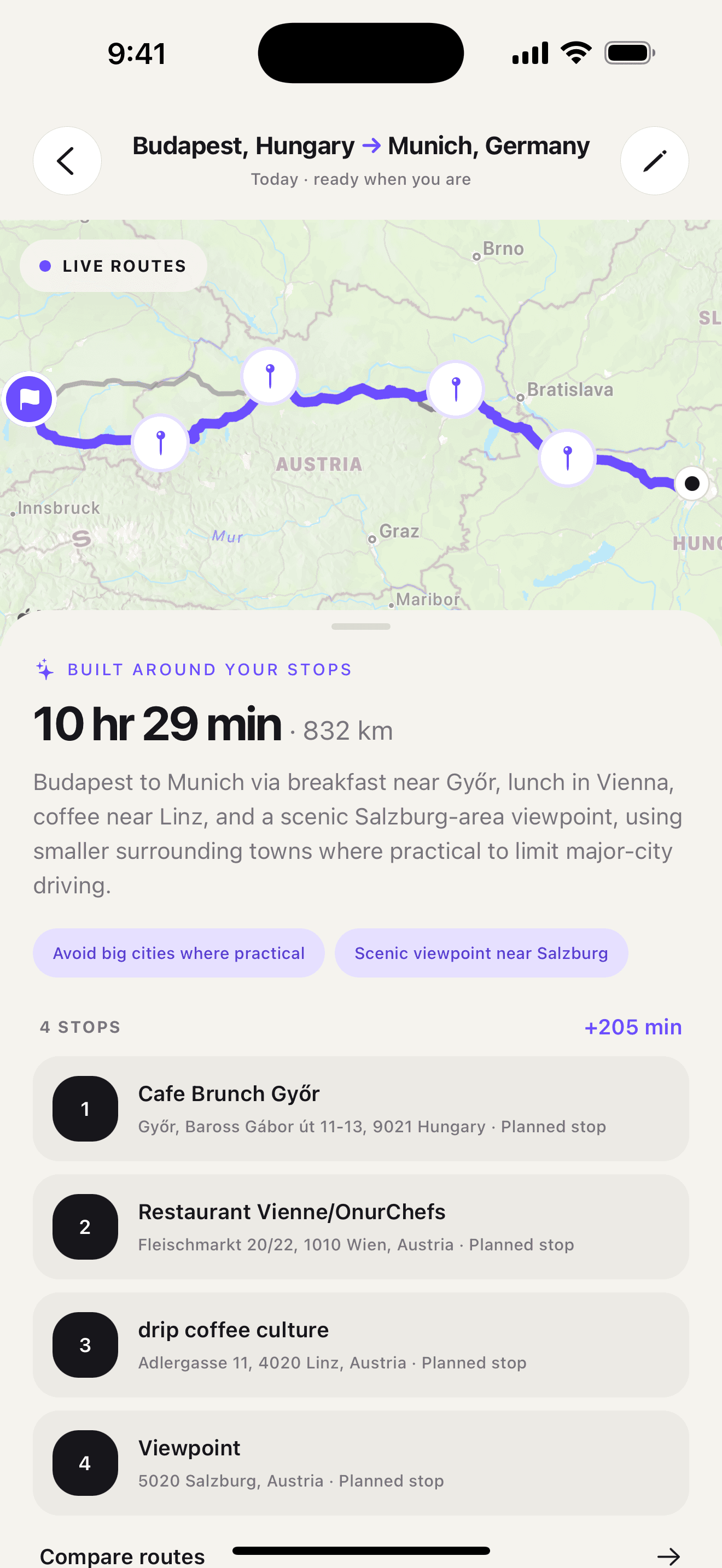
Ownway is useful when you know the timing and purpose of the breaks but not the exact places. A complete request could say:
Plan a six-hour drive from Vienna to Prague. Add a proper rest break after about two hours, lunch roughly two hours later, and fuel before the final section. Keep every stop close to the route and include practical alternatives.
Ownway can find and order suitable places, compare the planned itinerary with direct routes, and hand the chosen drive to Apple Maps, Google Maps, or Waze. It does not assess whether a person is fit to drive, monitor fatigue, or replace the driver's decision to stop earlier. Current place data can also change, so verify important hours and facilities before relying on a stop.
Sources
- The Highway Code: Rules for drivers and motorcyclists (89 to 102)UK Department for Transport · Accessed October 30, 2026
- Drowsy Driving: Avoid Falling Asleep Behind the WheelNational Highway Traffic Safety Administration · Accessed October 30, 2026
- Summer Driving & Road Trip TipsNational Highway Traffic Safety Administration · Accessed October 30, 2026
- Driver Fatigue on the JobCDC / NIOSH · Accessed October 30, 2026
- ownway: Multi-Stop PlannerApple App Store · Accessed October 30, 2026
- Ownway: Route & Stop PlannerGoogle Play · Accessed October 30, 2026